Research Article | DOI: https://doi.org/10.31579/2690-8808/026
BScE, DULE, 23 Park Ave., Saint John, NB E2J 1R2, Canada
*Corresponding Author: Paul T E Cusack, BScE, DULE, 23 Park Ave., Saint John, NB E2J 1R2, Canada.
Citation: Paul T E Cusack, (2020) On Dennett’s: ‘Consciousness Explained. J Clinical Case Reports and Studies, 1(5): Doi: 10.31579/2690-8808/026
Copyright: © 2020. Paul T E Cusack. This is an open-access article distributed under the terms of the Creative Commons Attribution License, which permits unrestricted use, distribution, and reproduction in any medium, provided the original author and source are credited.
Received: 01 September 2020 | Accepted: 03 September 2020 | Published: 08 September 2020
Keywords: consciousness; astrothoelogy math; evolution; mind
In this paper, we apply mathematics to some of the ideas presented in DC Dennett’s book: “On Consciousness. We see that such an approach can explain how the human mind and consciousness evolved. We use electrical engineer to devise a circuit of the mind.
DC Dennett has written a book wherein he describes the functioning of the human mind. His description is in words. In this paper, I put numbers and functions and math to how I think the mind works. We will see how the sense evolved to meet the universal signal. A knowledge of AT Math is helpful from my previous papers on Astrotheology. We being with the familiar Clairnaut equation.
Clairnaut Differential Equation
d²E/dt²-G=0
∫∫d²E/dt²= ∫∫G
E=G³/3
E=(6.67)³/3=0.9891=√π=Power
@E=0 Minimum
0=G³/3=(1-ln π)7
=(-0.1447)7
=0.000001330 ~0
Now, 221/2xG=0.6994~7
1/7=Economic Multiplier
1/6.997=14.29%
=1/7
e1429=1.1536=1/0.866=1/sin 60°
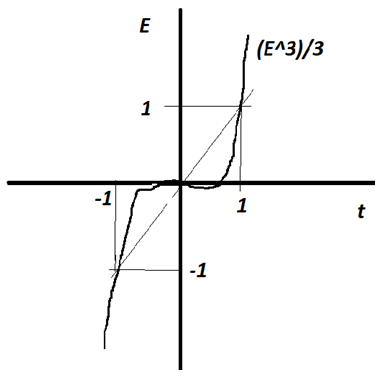
Univ. Signal =1/√3
1/π=freq of the human mind
s=4/3=|E||t| sin θ
4/3=E(π)sin θ
4/3 (1/π)=sin θ
0.4244=sin θ
θ=25.1=Period T
=0.4383 rads
Continuing:
1/π=s ·t
1/π=Et²sin θ
Et² sin θ-1/t=1/√3
Et²sin θ -1/t-1/√3=0
(1)(π)²sinθ-1-1/√3=0
π²sin θ=15773
sin θ=1593
θ=9.17°=0.16 rads
90°-9.17=0.80829=1/ (0.1234567)

v=d/t
3= (221)/t
t=6.990~7
1/t=E=1/7=0.1430
(0.1430)7=1.226
1/1.266=2.04~2=L = Reaction Time
t²-t-1=1
t²-t-2=0
t=2;-1
Prime Numbers by Gauss
Lim x→∞ π(x)/[ x/Ln x]=1
12/ [31/31]
=3.49~3.5
SE=SE’
t²-t-1=2t-1
5=5
t=0; 3
Fro reaction time t=0.200 sec
E=1/t=1/0.2=5
t²-t-1=E=12/t=1/0.2=5
t²-t-6
t=3;-2
ΔE=1/Δt
ΔE ·Δt= 1
5·Δt=1
5(0.2)=1
True!
Moment of Creation
Mom.=F ×d
t=f×d
1=F d(1/t)
1=(2.666)d(5)
d=0.75=3/4=1/s
st=1
s=1/t=E
E=s=Etsinθ
1=1 sin θ
θ=π/2
s=Etsinθ
4/3(1/5)=tsinθ
0.2666/2.666=1/10
F=(1)sinθ
F=sinθ
sin²θ+cos²θ=1
Let sin θ=cos θ
2sin² θ=1
sin =1/√2
(sin θ)’=cos θ
(sin π)=0=cos θ
θ=π/2
Consciousness=∫ t²-t-1=E
2t³/3-t²/2-t=E
t²-3/4t-1=1/√3
t²-0.75t-1.577=0
t=0.852; 1.852
E=1/t=54; 1.174
PE=Mc²
54=M(8.9)=6.00
PE=Mc²
1.174=M (8.9)
M=0.1307
A=1/2bh
A=2 x 1/2 bh
A=bh
211 x 221/2
=2.14175
2.14175/3=23.830
Ln 23.03=3.136~π
y=y’
Ln t=1/t
1/t=1/3.136~1/π=freq
For the four triangles:
2x 1/π=2/π=0.6366=t0 Moment of Creation
t²-t-1=0
|D|=4 E=11 ⇒ 11 dimensions
Eigenvalue =3 E=5 ⇒ SE=SE’
Eigen Vector=√3 E=2.67 ⇒ S.F.
P=i²R²
=(4/3)²(2.67)
=4.78
=1/231
=Fdt
1/21=2.67(221)(t
t=85
E=1/t=1/0.85
=117.6
Π Senses
F=Ma
2.67=M(1/√2)=3.776=1/265
F=Ma
2.67=117.6a
a=1/44=2.27
265/227=116.6=Mass of the periodic table
V=iR
=(4/3)(-2)=-8/3
F=-ks
=-/83=-0.4233s
s=6.3=1/0.1587
=1/[1-sin1]
=1-csc 60°
=1/Moment
=1/t=E
Π senses=2.67=SF
The Concept of Multiple Drafts of Consciousness
Consciousness=sin² θ +cos² θ=1 =t=[1/ (1-Ln t)]
t=1=(1-Ln t)-7
t=1/(1-Ln t)7
(1-Ln t)7/7=11/7
1-Ln t=1
Ln t=0
t=1
=ΣSenses= 1/π +π+√0.666)+4+√3=1.0008
E=t²-t-1=(1²)-1-1=-1
E=(1-Ln t)7=-1 @t=1
Freq=1/T=1/(1/t)=t=1
E=(1-Ln t)
Temporal Window
1≤t≤π
E=(1-Ln t)
=(1-Ln 1)=1
E=(1-Ln t)
=(1-Ln π)
=-0.1447
t=1/E=-6.909
Period T=251.6 1/T=397
Δt=691-397 msec
=294 ~300 Speech Act.
E=(1-Ln t)7
=(1-Ln (294))7
=502.6~500 msec which is equal to the reaction time for a touch.
The Mind is a magnetic field with L=2 Henries
Ln 2=0.693~7
(1-Ln (294))0.693
=√3
Universal Signal is the inverse =1/√3
The Mind is tuned to the universal signal.
358 msec-200 msec=1580 msec=1-sin 1
(1-sin 1)7=(1-Ln t)7
(1-0.8414)7=279=1/358 =1/t=E
Sin 1=Ln t
t==232 E=431
358 msec-200 msec=1580 msec=1-sin 1
(1-sin 1)7=(1-Ln t)7
(1-0.8414)7=279=1/358 =1/t=E
ΔE=232-(1/358)
=0.232-2.7932
=256.1
E=(1-Ln t)7
=(1-Ln 256.1)
=595~6
t=1.681
1.681²-1.681-1=0.1447=E~1/7
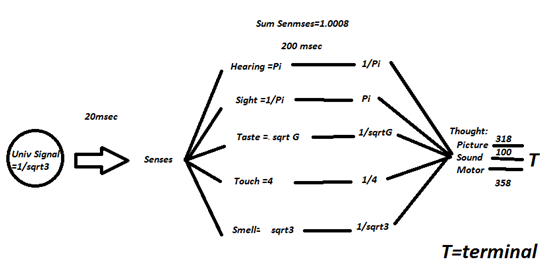
20+200+318=538 Pictures
1-0.380=-0.62=Ln 0.538
380 Hz =Light
20+200+100=320~318=1/π Speech
20+200+358=570=1/√3 Smell/Memory /Motor
E=1-Ln (0.538)=1.619~1.6183 Golden Mean
t=1/E=0.617~0.618=(-1)=i=j
0.020+1+0.200+0.358=157.8=π/2=90° Real -Imaginary
V=sin 60 +j(π/2)
=0.866+970
=183/6
1/V=1/183.6= 0.5444
0.5444/ √3=0.31446~π=1/E=t
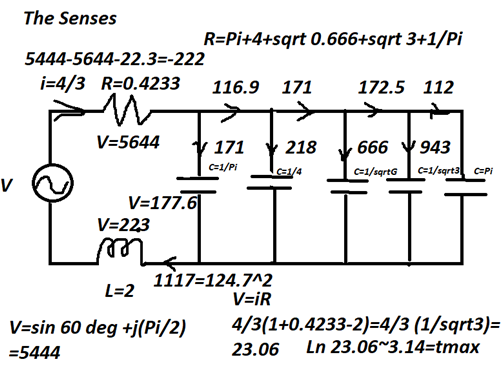
Note:
Amps across inductor =1117=1/c²
P=i²R
1.776=(4/3)² x R
R=1
=Σ Senses
Reaction Times:
1Amp=1 Coulomb/sec
t=1.602/A
Hearing 1.602/171=93.7+220=314=π
Touch 1.602/218=734+220=954
Taste 1.602/666=240+220=460
Smell 1.602/943=170+220=390
Sight 1.602/1115=144+220=364
Range of reaction times:
314≤t≤954
Δt=(1-Ln t)-7
tmin=(1-Ln .314)-7
=8857
1/t=E=112.8
tmax=(1-Ln .954)=471
1/t=E=21.23
ΔE=112.8-21.23=1350=1/74
Motor: 220+358=578 msec=1/√3 =Univ.Signal
E=(1-Ln t)7
t=(1-Ln 578)1/7
=1353 Cf 1350
E=1/t=1/1350=0.738~74
E= 73.8=(1-Ln t)7
73.81/7=(1-Ln t)
0.8486=Ln t
t=23.365
~Ln π=Mass
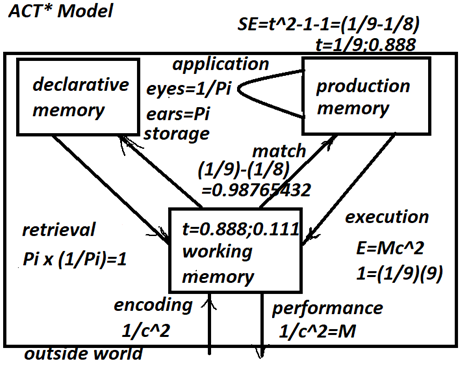
Now for the evolution of human consciousness:
Human Functions=5 Senses
R=1
P=i²R
177=(4/3)²(1)
P=VA
1777=V A
177=V($/3)
V=4/3
V=ir
4/3=(4/3)(1)
Universal Circuit:
V=ir
(4/3)(0.4233)=3.14
V=iR
=(4/3)(1/π)=0.4233
V=iR
=(4/3)(2)=8/3
VT=3.14+0.4244-8/3=89.84=2.997²=c²
Now:
RT=π=1/π+4+√(0.666)+√3=1.0008~1
Multiple Drafts of Consciousness= Senses= Consciousness
E=(1-Ln t)7=1=sin² θ +cos² θ
t=1
Let sin θ =cos θ
θ=45°
E=(1-Ln 1)7=1
=sin² θ +cos² θ=1
2 sin² θ=1
sinθ=1/√2
θ=45²
Mind=(1-Ln t)7
Let t=π
Mind=(1-Ln π)7=0.000001330
1330 =Internal Clock.
Now from the Circuit of the senses:
5644-5444=0200msec=0.2
1/0.2=5=E
SE=SE’
t²-t-1=2t-1
Let t=3
5=5=E
Consider the input to the Mind as 1/c²
E=Mc²
1=Mc²
M=1/c²
1/c²=Mass=1/0.8982=
0.1113
1/E=Ln t
E1/E=946
E=1057=(-70 mV)+(35mV)=PE of a nerve cell.
1/V=M
1/E=Ln t
M=1/c²=Ln t
0=Ln t
t=1
Now for the reaction time of the senses:
Motor 338msec
Sight 318
Hearing 100
Taste=460
Touch 954
Σ2190/5=438 =Average.
20+200+438=658
Range
tmin=(1-Ln 0.318)7=589
tmax=(1-Ln 0.954)7=936
Δt=588
Emin=1/589=16977
Emax=1/936 =1.0683
ΔE=17/2=0.8493
PE=Mc²
17/2=Mc²
M=946
M= Ln t
t=257.6
Equations of consciousness:
sin ² θ +cos² θ=1=t=(1-Ln t)7
t=1-(1-Lnt)-7
1-17=0=(-Ln t)-7
0.8571/7=(-Ln t)-1/7
33.99=(-Ln t)-1
Ln t=-1/33.99
=294.2
E=(1-Ln t)7
E=251.6=Period T
=1/freq
freq=1/397=1/4=Touch ⇒ Pleasure and Pain
E=(1-Ln t)
1≤t≤π
E=(1-Ln 1)
=251.6
t=397
E=(1-Ln t)
=-0.1447
t=6.31
Δt=691-397=294=Speech Act 100+200=300 msec
The Mind as a magnetic field:
L=2
Ln 2=0.693~7
(1-Ln 0.294)0.693
=√3
=Smell
So we have evolution working on the four F’s (Flight Feed, Fight; ; Mate)
Sight =65%
Taste=17%
Smell=12%
Hearing (Language)=6.5%
Touch =5%
65%+17%+12%+6.5%+5%=105=(-70+35)mV
Touch= e105=4=|D|
Smell=√3=Eigen vector
ΣSenses=1=Consciousness
ΔV=_70+35=105mV
V=iR
105.0=(4/3)(R
R=2625=1/380 Hz Light = 1/Sight =1/t
t=π Hearingfreq=1/π
Taste=√0.666=√G
G=1/150 =Language group.
θ=60°=π/3
1/c=3 =1/Eigen value
t²-t-1
=3²-3-1=5 ⇒ SE=SE’
t=1.618; -0.618 t cannot be negative. So, t=1.618
Dear Editorial Team, Clinical Medical Reviews and Reports. My experience with the journal was highly positive. The peer-review process was rigorous, constructive, and completed in a timely manner. The reviewers provided valuable comments that helped improve the quality and clarity of our manuscript. The editorial office was professional, responsive, and supportive throughout all stages of the publication process. Communication was clear and efficient, and any questions were addressed promptly. Overall, I found the journal to maintain high scientific standards and an excellent publication workflow. I would be pleased to consider submitting future work to this journal. Best wishes from, Elena Popa.

It was my pleasure to submit my testimonial concerning the Reviewer Board of our Scientific Journal “Brain and Neurological Disorders”. The Reviewers focused on some modifications and their contribution was helpful. The ladies of our Editorial Office were also supported my efforts. It was my honor to have such a co-operation and I am looking forward for more collaboration.
Dear Grace Pierce, Editorial Coordinator of Journal of Clinical Research and Reports, Thank you for the speedy and efficient peer review process. I appreciate the fact that your peer reviewers do not take months to respond like with some other journals. I would also like to thank the editorial office for responding quickly to my questions. It is an excellent journal. I plan to submit more manuscripts in the future. Best wishes from, Robert W. McGee

Dear Grace Pierce, Editorial Coordinator of Journal of Clinical Research and Reports, Working with you and your team on our recent publication in JCRR has been a truly wonderful and enjoyable experience. The responses were prompt, and the reviewers were patient, constructive, and highly professional. One reviewer in particular gave me the feeling that a professor was carefully reading and commenting on my coursework, which was deeply touching. The entire process was straightforward and hassle‑free, with no tedious online forms to complete. I highly recommend this journal. Best wishes from, DR Aibing Rao, Head of R&D

I Appreciate the Opportunity to Share my Experience with the Journal of Clinical Research and Reports. The peer review process was timely and constructive, and the feedback provided helped improve the quality of our manuscript. The editorial office was professional, responsive, and supportive throughout the process, ensuring smooth communication and efficient handling of the submission. Overall, it was a positive experience collaborating with your team.

Dear Mercy Grace, Editorial Coordinator of Obstetrics Gynecology and Reproductive Sciences, We would like to express our gratitude for your help at all stages of publishing and editing the article. The editors of the magazine answer all the necessary questions and help at every stage. We will definitely continue to cooperate and publish other works in the Obstetrics Gynecology and Reproductive Sciences! Best wishes from, Alla Konstantinovna Politova,